Speech Intelligibility vs SNR: Understanding the Curve
The relationship between signal-to-noise ratio and speech understanding follows a characteristic S-shaped curve. Understanding this curve explains why small SNR improvements can have a dramatic impact on real-world hearing.
The Psychometric Function for Speech
When researchers test speech understanding at different noise levels, they plot the results as a psychometric function — a graph showing percentage of words understood (y-axis) versus signal-to-noise ratio (x-axis).
This curve is characteristically S-shaped (sigmoid). At very poor SNRs (e.g., −10 dB), understanding is near zero. As SNR improves, understanding rises slowly at first, then steeply through the middle range, and finally levels off as it approaches 100%.
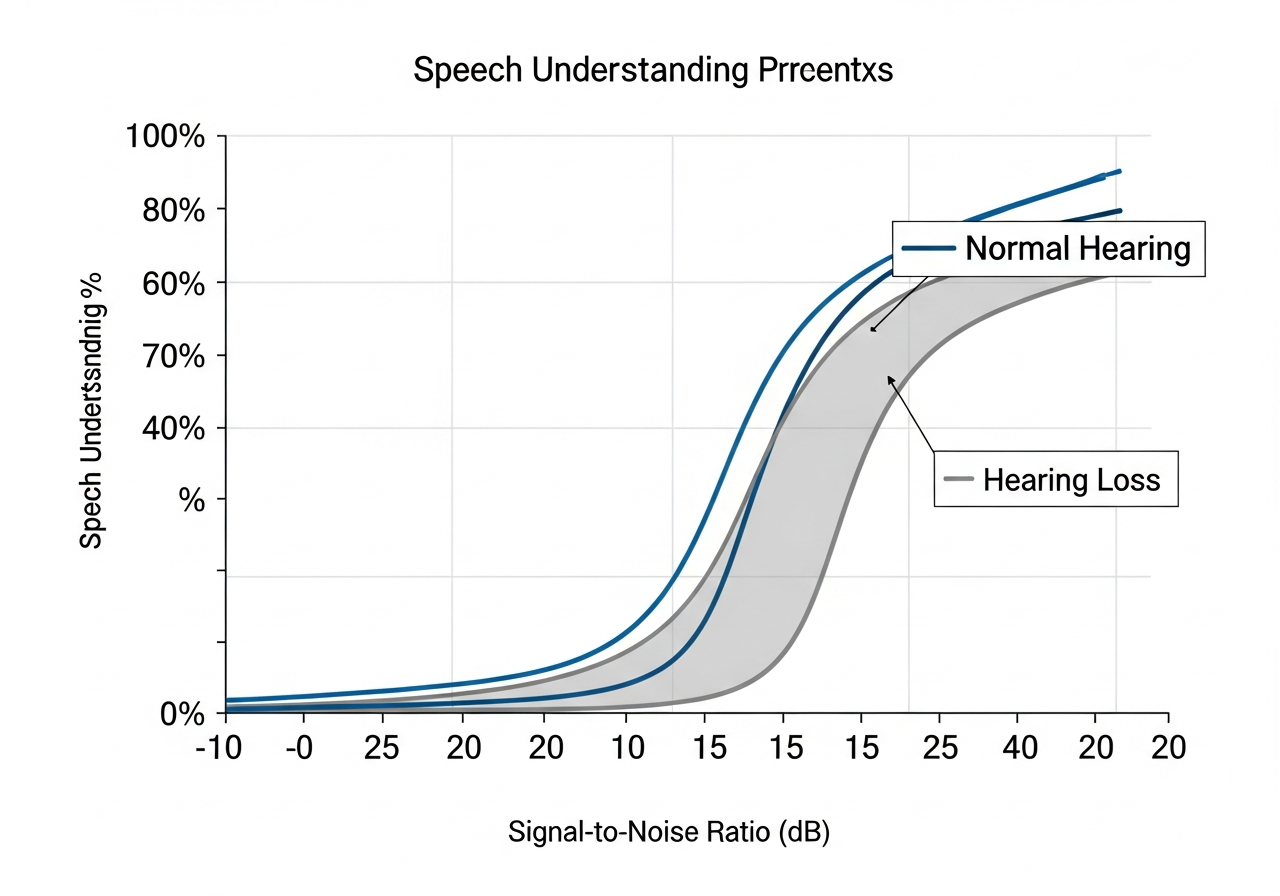
The steepest part of the curve — where small SNR changes produce the largest changes in understanding — is the critical zone for hearing aid benefit. Most real-world noisy environments place listeners right in this steep region.
What Is SNR50?
SNR50 is the signal-to-noise ratio at which a listener correctly understands 50% of the speech material. It serves as the standard benchmark for comparing speech-in-noise performance because it falls on the steepest part of the psychometric function, making it the most sensitive measure of change.
For normal-hearing young adults, SNR50 is typically around −2 to −6 dB for sentence-level material — meaning they can understand half the speech even when noise is louder than the speech. For listeners with moderate sensorineural hearing loss, SNR50 may be +3 to +10 dB or worse.
The difference between these values — often 5–15 dB — represents the SNR loss, which quantifies how much harder it is for a hearing-impaired person to understand speech in noise compared to a normal-hearing listener. This SNR loss cannot be overcome by amplification alone, which is why hearing aids struggle in noise.
Why Small SNR Improvements Matter So Much
On the steep part of the psychometric function, a 1 dB improvement in SNR can translate to 7–15% improvement in word recognition. This is a remarkably steep relationship:
- A 1 dB improvement: ~10% better word recognition
- A 3 dB improvement: ~25–35% better word recognition
- A 5 dB improvement: ~40–50% better word recognition
This is why even modest SNR improvements from directional microphones (1–5 dB) are clinically meaningful, and why remote microphones (10–15 dB improvement) can be transformative. The nonlinear nature of the psychometric function means that every decibel counts.
How Hearing Loss Changes the Curve
Sensorineural hearing loss affects the psychometric function in two ways:
Rightward shift: The entire curve shifts to higher SNRs, meaning the listener needs more favorable conditions to achieve the same level of understanding. A normal-hearing person might understand 80% of speech at 0 dB SNR, while a hearing-impaired listener might need +8 dB SNR for the same score.
Shallower slope: For some listeners, the curve becomes less steep, meaning SNR improvements produce smaller gains. This is more common with severe or profound hearing loss and reflects the reduced frequency resolution and temporal processing that accompany significant cochlear damage.
Understanding where a patient falls on the curve helps clinicians set realistic expectations and choose the right technology. Patients operating on the steep part of the curve will benefit most from SNR improvements, while those on the shallow tail may need additional strategies.
Clinical Significance
The speech-intelligibility curve has direct implications for hearing aid fitting and counseling:
- Technology selection: Different hearing aid technologies provide different amounts of SNR improvement. Matching the technology to the patient's SNR needs is critical.
- Realistic expectations: If a patient's SNR50 is +8 dB and a restaurant provides 0 dB SNR, even a 5 dB improvement from beamforming still leaves them below their SNR50.
- Outcome measurement: Real-world SNR measurements can predict where on the curve a patient will fall in specific environments.
- Accessory recommendations: When the gap between available SNR and needed SNR is large, remote microphones may be the only technology that can bridge it.
The SNR concept is central to all of these decisions. By measuring SNR50 and understanding the psychometric function, clinicians can make evidence-based recommendations rather than relying on trial and error.
Frequently Asked Questions
What is SNR50?
SNR50 is the signal-to-noise ratio at which a listener understands 50% of the speech material. It is the most commonly used metric for comparing speech-in-noise performance across individuals and devices. A lower (more negative) SNR50 indicates better performance.
Why does a 1 dB SNR improvement matter?
On the steep portion of the psychometric function, a 1 dB improvement in SNR can translate to a 7–15% improvement in word recognition. This is because the relationship between SNR and intelligibility is not linear — small changes near the 50% point produce large changes in understanding.
What is a psychometric function for speech?
A psychometric function plots the percentage of words or sentences correctly understood against the signal-to-noise ratio. For most speech materials, this creates an S-shaped (sigmoid) curve that transitions from near-zero understanding at very poor SNRs to near-perfect understanding at favorable SNRs.
How does hearing loss affect the SNR-intelligibility curve?
Hearing loss shifts the entire psychometric function to the right, meaning listeners need a higher SNR to achieve the same level of understanding. The curve may also become shallower, meaning SNR improvements produce smaller gains. Severe losses may never reach 100% even at very favorable SNRs.
Related Topics
Scott Johnson
Hearing Technology Analyst
Scott Johnson analyzes hearing aid signal processing and speech-in-noise performance. His work focuses on signal-to-noise ratio (SNR), directional microphones, and real-world hearing aid technology evaluation.
Related Articles
Watch: SNR Explained: The Science of Hearing in Noise
What signal-to-noise ratio means, how it is measured, and why each 1 dB improvement corresponds to roughly 7–10 percentage points better word recognition.
Covers dB measurement, speech intelligibility, and what SNR improvement means in practice.