Beamforming vs Directional Microphones in Hearing Aids
Both beamforming and directional microphones aim to improve speech understanding in noise, but they work very differently. This guide explains the distinctions, when each technology excels, and what the research shows.
How Traditional Directional Microphones Work
Traditional directional microphones use two sound ports separated by a small distance on the hearing aid shell. By comparing the time delay between sound arriving at each port, the system creates a polar pattern that is more sensitive to sounds from the front than from the sides and rear.
Fixed directional systems maintain a constant polar pattern (such as cardioid or hypercardioid). Adaptive directional systems can shift the null point — the direction of maximum noise rejection — to track moving noise sources. Both approaches typically provide 1–3 dB of SNR improvement in laboratory conditions.
How Beamforming Works
Beamforming extends the directional concept by using multiple microphone elements (often across both ears in a binaural system) and sophisticated digital signal processing. Rather than a simple two-port comparison, beamforming algorithms combine signals from several microphones to create a narrow, steerable beam focused on the talker.
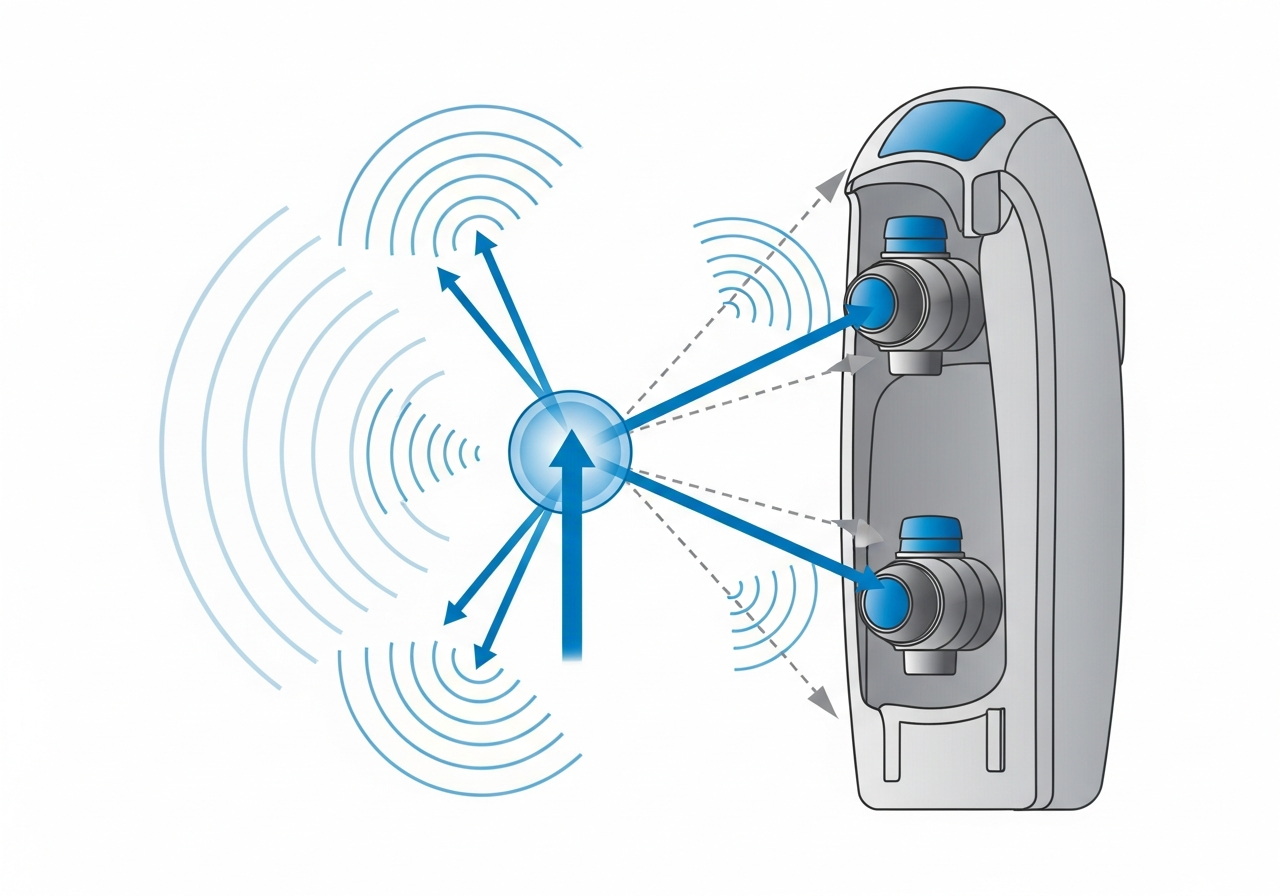
Modern beamforming systems can adapt in real time, tracking the primary speaker and adjusting the beam width and direction. Binaural beamforming, where left and right hearing aids share microphone data wirelessly, can achieve even narrower beams and 2–5 dB of SNR improvement.
Key Differences at a Glance
| Feature | Fixed Directional | Adaptive Directional | Beamforming |
|---|---|---|---|
| Microphone ports | 2 per ear | 2 per ear | 2+ per ear, often binaural |
| Beam pattern | Fixed | Adjustable null | Steerable, narrow beam |
| SNR improvement | 1–3 dB | 2–4 dB | 2–5 dB |
| Multi-talker handling | Limited | Moderate | Better |
| Processing demand | Low | Moderate | High |
When Does Each Technology Help Most?
Fixed directional microphones work well in simple listening situations with one dominant noise source, such as a one-on-one conversation with steady background noise behind you. They also perform consistently in situations with minimal reverberation.
Adaptive directional systems shine when noise sources move around, such as walking along a busy street. The null point tracks the strongest noise source automatically, providing a meaningful advantage over fixed patterns.
Beamforming provides the greatest advantage in complex, multi-talker environments like restaurants, parties, or meetings. The narrow beam can isolate a single speaker even when noise arrives from multiple directions. However, even beamforming has limits in highly reverberant rooms where reflected sound arrives from all directions.
Clinical Evidence
Research consistently shows that directional microphone technology improves speech understanding in noise compared to omnidirectional mode. A meta-analysis of directional benefit studies found average improvements of 2–4 dB SNR for adaptive systems in controlled conditions.
Binaural beamforming studies report additional benefits of 1–2 dB beyond monaural adaptive directionality. While 1–2 dB may seem small, it translates to roughly 10–20% improvement in word recognition scores — a clinically meaningful difference.
Real-world studies show somewhat smaller benefits than laboratory results, largely because real environments have reverberation and multiple noise sources that reduce the effectiveness of all directional approaches. This is why remote microphones often outperform even the best beamforming systems.
Limitations to Keep in Mind
All directional approaches — including beamforming — share some inherent limitations. In highly reverberant environments, sound reflections arrive from every direction, reducing the benefit of spatial filtering. The user must also face the speaker for directional systems to work well.
Wind noise can disrupt directional microphone performance, and some systems automatically switch to omnidirectional mode in windy conditions. Additionally, directional processing can reduce awareness of environmental sounds, which may be undesirable in some situations (e.g., detecting traffic sounds while walking).
Frequently Asked Questions
What is the difference between beamforming and directional microphones?
Traditional directional microphones use two ports to create a fixed sensitivity pattern that reduces sound from the sides and rear. Beamforming uses multiple microphones with advanced digital signal processing to steer a narrow beam toward the target speaker, adapting in real time to changing noise conditions.
Which technology provides better SNR improvement?
Beamforming systems typically provide 2–5 dB SNR improvement in complex environments, while fixed directional microphones may offer 1–3 dB. The advantage of beamforming grows in multi-talker scenarios where noise shifts in location.
Do all modern hearing aids use beamforming?
Most premium-tier hearing aids now include some form of beamforming. Mid-range devices may use simpler adaptive directionality. Basic models often rely on fixed directional patterns. The specific implementation varies significantly by manufacturer.
Related Topics
Scott Johnson
Hearing Technology Analyst
Scott Johnson analyzes hearing aid signal processing and speech-in-noise performance. His work focuses on signal-to-noise ratio (SNR), directional microphones, and real-world hearing aid technology evaluation.
Related Articles
Watch: How Directional Microphones Work in Hearing Aids
Learn how directional mics reduce noise from behind and to the sides, adding 2–5 dB of SNR benefit when conditions are right.
Covers polar patterns, beamforming, adaptive directional modes, and real-world limits.