Signal-to-Noise Ratio (SNR) in Hearing Aids Explained
SNR is the single most important predictor of speech understanding in noise. This guide explains what SNR means, how hearing aid technologies improve it, and why even small dB gains translate to meaningful real-world benefits.
What Does SNR Mean?
Signal-to-noise ratio (SNR) is the difference in decibels (dB) between the level of the desired speech signal and the level of background noise. When SNR is positive, speech is louder than noise; when SNR is negative, noise dominates.
For example, if someone is speaking at 65 dB and background noise is at 60 dB, the SNR is +5 dB. In a busy restaurant where noise reaches 70 dB and speech remains at 65 dB, the SNR drops to −5 dB—making conversation extremely difficult, especially for people with hearing loss.
Normal-hearing listeners can typically understand speech well at SNRs around 0 dB. However, hearing aid users often need an SNR of +5 to +15 dB to achieve the same level of understanding. This gap—sometimes called the "SNR loss"—is why noisy environments are the number-one complaint among hearing aid wearers.
How SNR Affects Speech Intelligibility
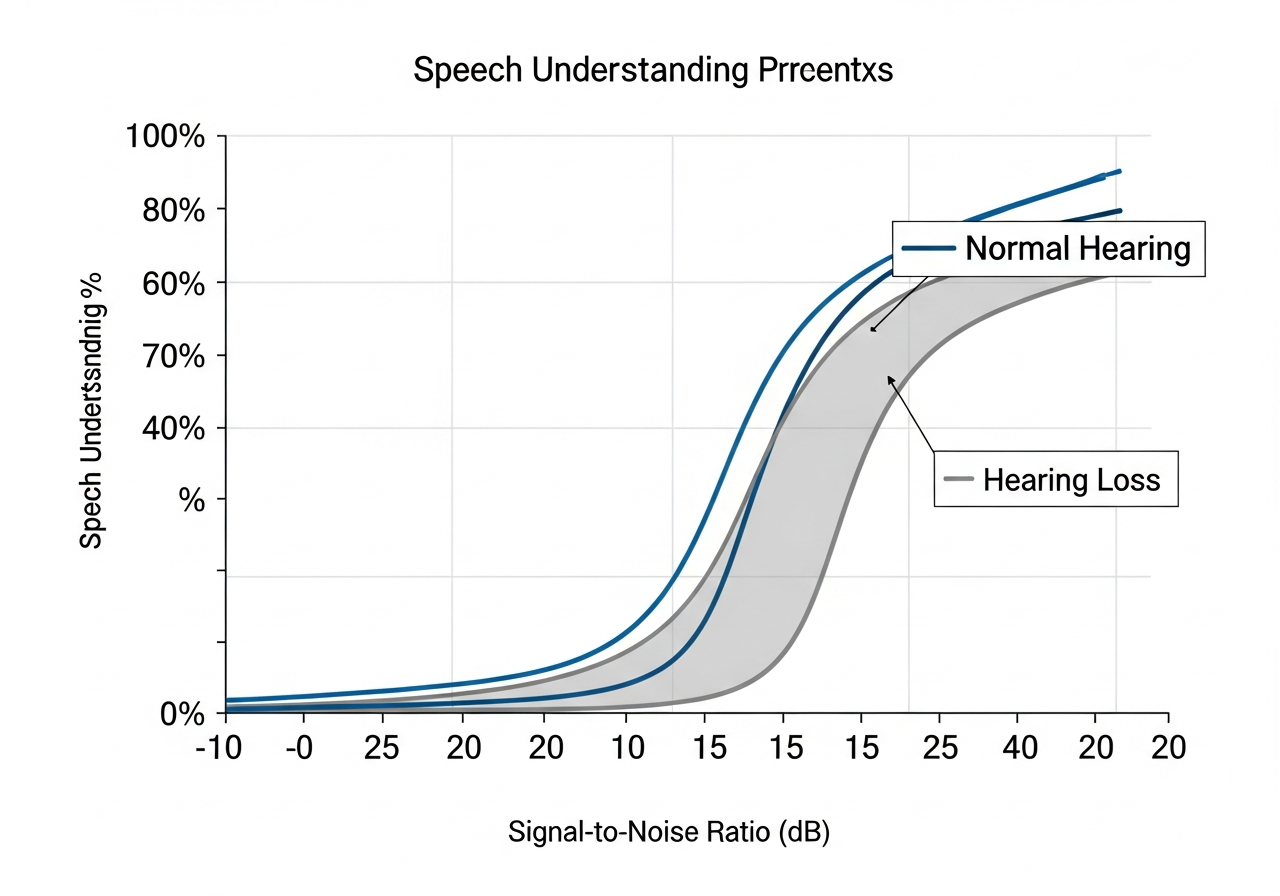
The relationship between SNR and speech understanding follows a characteristic S-shaped curve called the psychometric function. At very low SNRs (e.g., −10 dB), almost no speech is understood. At very high SNRs (e.g., +20 dB), understanding approaches 100%. The critical region lies in between—typically between −5 and +10 dB for hearing aid users.
Within this critical region, small SNR changes produce dramatic shifts in intelligibility. A 1 dB improvement in SNR can increase word recognition by approximately 7–10 percentage points. A 3 dB improvement—achievable with modern directional microphones—can boost intelligibility by 20–30 percentage points.
Key insight: Because the psychometric function is steepest near the listener's threshold, even modest SNR improvements from hearing aid technology translate to substantial real-world speech understanding gains.
Typical SNR Improvement Values
Different hearing aid technologies provide varying degrees of SNR improvement. Understanding these values helps set realistic expectations and choose the right solution for each listening situation.
Directional Microphones: 3–5 dB
Fixed directional microphones reduce sensitivity to sounds arriving from the sides and behind, providing roughly 3 dB of SNR improvement. Adaptive directional systems that track and suppress the dominant noise source can achieve 4–5 dB in favorable conditions. However, performance decreases in reverberant or diffuse-noise environments.
Beamforming Technology: 5–6 dB
Advanced binaural beamforming—where both hearing aids communicate wirelessly to create a focused beam—can yield 5–6 dB of SNR benefit. This represents the current upper limit of on-ear microphone technology for most manufacturers.
Remote Microphones: 10–15+ dB
Remote microphones bypass room acoustics entirely by capturing speech near the talker and transmitting it wirelessly to the hearing aids. This approach routinely delivers 10–15 dB or more of effective SNR improvement, making them the most powerful technology for difficult noise environments like classrooms and restaurants.
Noise Reduction Algorithms: 0–2 dB (perceived)
Digital noise reduction (DNR) algorithms reduce listening effort and improve comfort but generally provide minimal measurable SNR improvement for speech intelligibility. Their primary benefit is reducing fatigue rather than improving word recognition scores.
Why Small Improvements Matter
It's natural to wonder whether a 3 or 4 dB improvement is worth the investment in premium hearing aid technology. The answer, based on decades of audiology research, is a clear yes—but the reasons are not immediately intuitive.
First, decibels are logarithmic. A 3 dB increase represents a doubling of sound intensity. When translated to speech understanding, this doubling pushes the listener past the steepest part of the intelligibility curve.
Second, real-world listening is cumulative. A person with hearing loss faces dozens of noisy conversations per day. Improving each one by even a moderate amount reduces overall listening effort, mental fatigue, and social withdrawal over weeks and months.
Third, SNR improvements stack. A hearing aid with 4 dB of directional benefit combined with a remote microphone providing 12 dB of benefit gives the listener a combined advantage of 16 dB—potentially transforming a completely unintelligible conversation into one that is easily followed.
Clinical perspective: Research by Killion (1997) demonstrated that each 1 dB of SNR improvement corresponds to approximately 10% better speech recognition in noise. This finding has been replicated across multiple studies and remains a foundational principle in hearing aid fitting.
Frequently Asked Questions
What SNR improvement do hearing aids provide?
Modern hearing aids with directional microphones typically provide 3–5 dB of SNR improvement. Premium models with adaptive beamforming can achieve up to 5–6 dB. Remote microphones can provide 10–15 dB or more of effective SNR improvement by capturing speech close to the talker.
What does SNR mean in hearing aids?
SNR stands for signal-to-noise ratio. It measures the difference in decibels (dB) between the level of the desired speech signal and the level of background noise. A positive SNR means speech is louder than noise; a negative SNR means noise is louder than speech.
Why is a 3 dB SNR improvement significant?
A 3 dB SNR improvement may sound small, but it can increase speech intelligibility by 20–30 percentage points in difficult listening conditions. This is because the relationship between SNR and speech understanding follows a steep psychometric function—small dB changes near the listener's threshold produce large changes in comprehension.
How is SNR measured for hearing aids?
SNR improvement is typically measured using standardized speech-in-noise tests such as the HINT (Hearing in Noise Test) or QuickSIN. These tests present speech at varying noise levels to determine the SNR at which a listener can understand 50% of the material (called the SNR-50 or SRT).
What is a typical SNR in a noisy restaurant?
In a busy restaurant, the SNR at the listener's ear is often 0 dB or worse (negative SNR), meaning background noise is as loud as or louder than the person speaking. This is why restaurants are one of the most challenging environments for hearing aid users.
Explore More Topics
Scott Johnson
Hearing Technology Analyst
Scott Johnson analyzes hearing aid signal processing and speech-in-noise performance. His work focuses on signal-to-noise ratio (SNR), directional microphones, and real-world hearing aid technology evaluation.
Related Articles
Stay Updated on Hearing Aid Research
Get evidence-based hearing aid comparisons and new analysis delivered to your inbox. No spam, unsubscribe anytime.
Watch: SNR Explained — The Science of Hearing in Noise
What signal-to-noise ratio means, how it is measured, and why each 1 dB improvement corresponds to roughly 7–10 percentage points better word recognition.
Covers dB measurement, speech intelligibility, and what SNR improvement means in practice.