What Is Signal-to-Noise Ratio in Hearing Aids?
Signal-to-noise ratio (SNR) is the most important factor determining whether you can understand speech in a noisy environment. This guide explains what SNR means for hearing aid users, how different technologies improve it, and why even small dB improvements make a meaningful difference in daily life.
Understanding SNR: The Basics
Signal-to-noise ratio (SNR) measures the difference in decibels (dB) between the level of the speech you want to hear and the level of background noise. When someone speaks at 65 dB in a room with 60 dB of background noise, the SNR is +5 dB — speech is 5 dB louder than noise.
In a busy restaurant where noise levels reach 70 dB and the speaker's voice arrives at your ear at 65 dB, the SNR drops to −5 dB. At this point, noise is louder than speech, and understanding becomes extremely difficult — especially for people with hearing loss.
Normal-hearing listeners can typically follow conversation at SNRs around 0 dB. However, people with hearing loss often need an SNR of +5 to +15 dB to achieve the same level of comprehension. This difference is called SNR loss and is the fundamental reason hearing aids need to improve the SNR to be effective in noise.
Why SNR Matters More Than Volume
Many people assume that making sounds louder is the solution to hearing difficulty in noise. In reality, simply turning up the volume amplifies both speech and noise equally, leaving the SNR unchanged. The brain still cannot separate the target voice from the competing sounds.
This is why modern hearing aids focus on improving the SNR rather than just increasing volume. Technologies like directional microphones and binaural beamforming selectively enhance speech from the front while reducing noise from other directions, effectively improving the SNR at the listener's ear.
Key principle: Speech understanding in noise depends on the ratio of speech to noise — not the absolute loudness of either. Improving SNR by even 1 dB can increase word recognition by 7–10 percentage points.
How Hearing Aids Improve SNR
Different hearing aid technologies target SNR improvement in distinct ways. Understanding what each technology contributes helps set realistic expectations and choose the right solution.
Directional Microphones: 3–5 dB
Directional microphones reduce sensitivity to sounds from the sides and behind, focusing on speech arriving from the front. Fixed directional modes provide approximately 3 dB of SNR improvement, while adaptive systems that track the dominant noise source can achieve 4–5 dB in favorable conditions.
Binaural Beamforming: 5–6 dB
Advanced binaural beamforming coordinates both hearing aids wirelessly to create a narrow listening beam. This represents the current upper limit of on-ear microphone technology, achieving 5–6 dB of SNR improvement. The Phonak Sphere and Oticon Intent are leading examples of this approach.
Remote Microphones: 10–15+ dB
Remote microphones bypass room acoustics entirely by capturing speech near the talker's mouth. This approach delivers the largest measurable SNR improvement — 10–15 dB or more — making it the most powerful solution for challenging environments like restaurants and classrooms.
AI Noise Reduction: 0–2 dB (perceived)
AI-powered noise reduction algorithms reduce the perceived loudness of background noise, improving listening comfort. However, they provide minimal measurable SNR improvement for speech intelligibility (typically 0–2 dB). Their main value is reducing listening effort and fatigue.
The SNR-Intelligibility Relationship
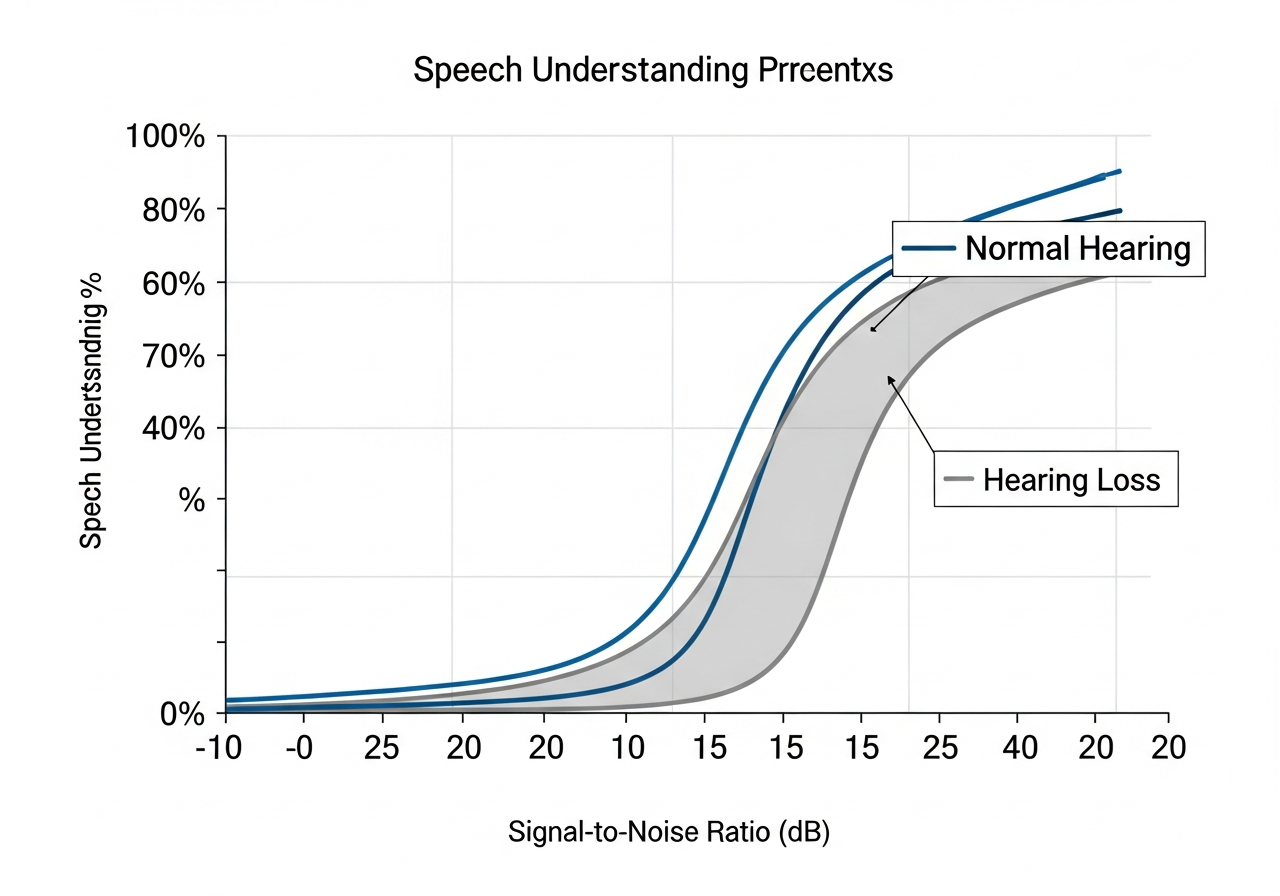
The relationship between SNR and speech understanding follows a steep S-shaped curve called the psychometric function. At very low SNRs (e.g., −10 dB), almost nothing is understood. At high SNRs (e.g., +20 dB), understanding approaches 100%. The critical region lies in between — typically −5 to +10 dB for hearing aid users.
Within this critical range, small SNR changes produce dramatic shifts in intelligibility. Research by Killion (1997) demonstrated that each 1 dB of SNR improvement corresponds to approximately 10% better speech recognition. This means a hearing aid providing 3 dB of directional benefit can boost understanding by 20–30 percentage points — the difference between catching one word in three and following most of a conversation.
For a deeper exploration of this relationship, see our guide on speech intelligibility vs SNR.
Real-World SNR Values
Understanding typical SNR values in everyday environments helps explain why certain situations are difficult and what level of technology support is needed.
Quiet living room: +15 to +20 dB SNR — speech is much louder than background noise. Most hearing aid users understand well in this environment.
Office or small meeting: +5 to +10 dB SNR — moderate background noise. Directional microphones provide meaningful benefit here.
Busy restaurant: 0 to −5 dB SNR — noise equals or exceeds speech level. This is where premium hearing aids and remote microphones become essential.
Crowded party or bar: −5 to −10 dB SNR — extremely challenging. Even normal-hearing listeners struggle. Remote microphones provide the only reliable solution at these levels.
For measured data from real environments, see our real-world SNR measurements page.
SNR Loss vs. Hearing Loss
An important clinical concept is that SNR loss and hearing loss (as measured on the audiogram) are independent. Two people with identical audiograms can have very different SNR loss values, meaning their ability to understand speech in noise can differ substantially even though their quiet-room hearing thresholds are the same.
This is why speech-in-noise testing is an essential part of a comprehensive hearing evaluation. A pure-tone audiogram alone cannot predict how well someone will perform in noisy environments — only a speech-in-noise test can reveal the true extent of their SNR loss.
Clinical tip: If you struggle in noisy environments but your audiogram looks "not that bad," ask your audiologist for a speech-in-noise test like the QuickSIN or HINT. The results may explain the disconnect between your hearing test and your daily experience.
Frequently Asked Questions
What is signal-to-noise ratio in hearing aids?
Signal-to-noise ratio (SNR) is the difference in decibels (dB) between the desired speech signal and background noise. A higher SNR means speech is clearer relative to noise. Hearing aids improve the SNR through directional microphones, beamforming, and noise reduction technologies.
Why is SNR important for hearing aid users?
SNR is the single most important predictor of speech understanding in noise. People with hearing loss typically need a higher SNR than normal-hearing listeners. Even small improvements of 1–3 dB can increase speech intelligibility by 10–30 percentage points in difficult listening environments.
How much SNR improvement do hearing aids provide?
Modern hearing aids with directional microphones provide 3–5 dB of SNR improvement. Premium models with binaural beamforming achieve 5–6 dB. Remote microphones deliver the most at 10–15+ dB by capturing speech close to the talker.
What is a good SNR for understanding speech?
Normal-hearing listeners can understand speech well at SNRs around 0 dB. People with hearing loss typically need +5 to +15 dB SNR for equivalent understanding. The gap is called "SNR loss" and varies by individual.
Can hearing aids fully solve speech-in-noise problems?
No single hearing aid can fully restore normal speech-in-noise understanding. However, combining on-ear directional technology (3–6 dB) with a remote microphone (10–15+ dB) can provide 15–20+ dB of total SNR benefit, making most noisy conversations manageable.
Explore More Topics
Scott Johnson
Hearing Technology Analyst
Scott Johnson analyzes hearing aid signal processing and speech-in-noise performance. His work focuses on signal-to-noise ratio (SNR), directional microphones, and real-world hearing aid technology evaluation.
Related Articles
Watch: SNR Explained: The Science of Hearing in Noise
What signal-to-noise ratio means, how it is measured, and why each 1 dB improvement corresponds to roughly 7–10 percentage points better word recognition.
Covers dB measurement, speech intelligibility, and what SNR improvement means in practice.