Remote Microphones for Hearing Aids: How They Improve Speech Understanding
Remote microphones capture speech close to the talker — before distance, reverberation, and background noise reduce the effective signal-to-noise ratio. They consistently deliver the largest SNR improvements available to hearing aid users.
How Remote Microphones Bypass Room Noise
The fundamental problem with hearing in noisy environments is that by the time speech reaches a hearing aid microphone, it has already been degraded. Sound loses energy as it travels (the inverse square law means intensity drops by 6 dB each time distance doubles), and reflections from walls, ceilings, and furniture add reverberation that smears the signal.
A remote microphone solves this by capturing speech at the source — typically within 15–20 cm of the talker's mouth. At this close distance, the speech signal is strong and clean. The microphone then transmits this signal wirelessly to the hearing aid, effectively replacing the degraded signal that would have arrived through the room.
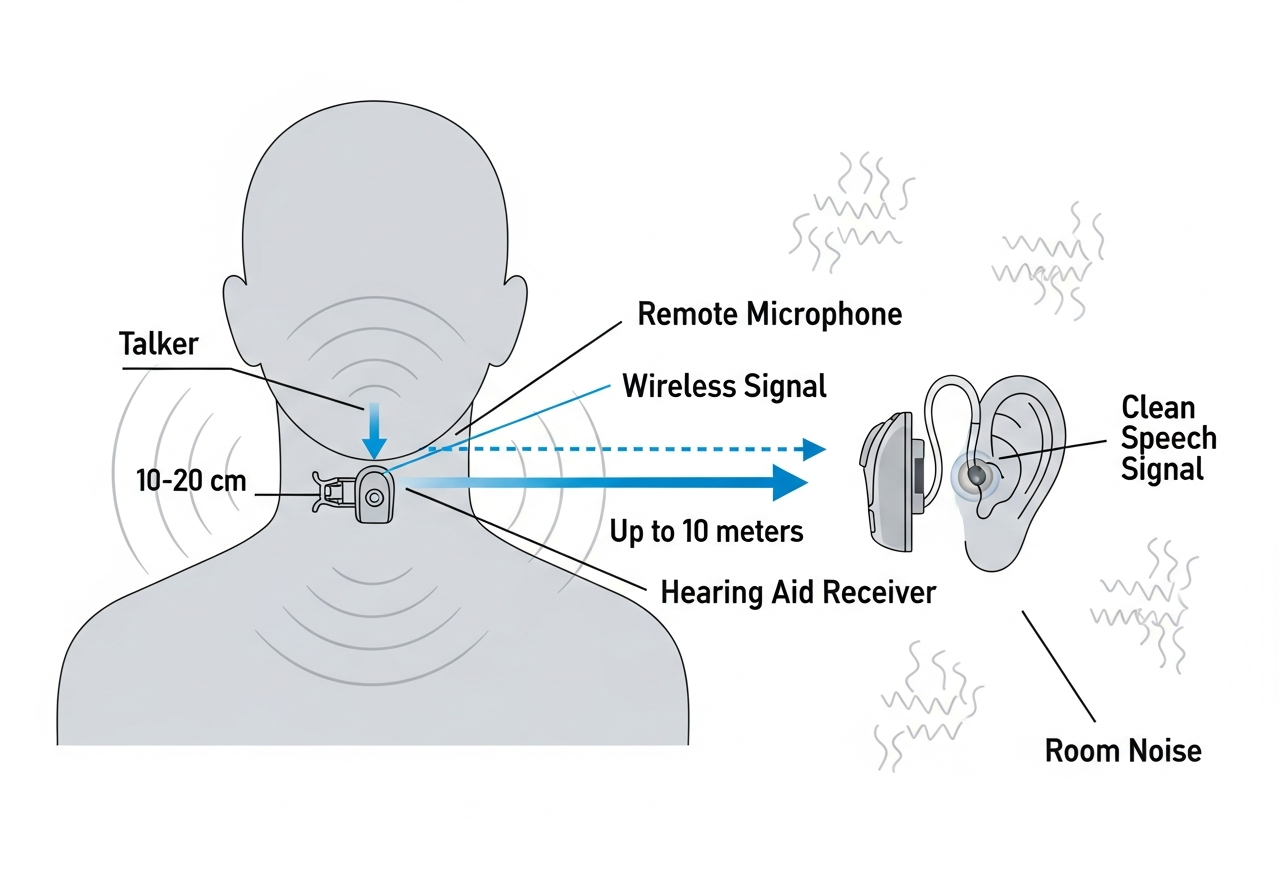
This approach is fundamentally different from what hearing aid processing does. Digital noise reduction and directional microphones try to separate speech from noise after the mixed signal reaches the ear-level mic. A remote mic prevents the mixing in the first place.
Typical SNR Improvements
Remote microphones consistently deliver the largest SNR improvements of any assistive listening technology:
| Technology | Typical SNR Improvement |
|---|---|
| Omnidirectional mic (hearing aid) | 0 dB (baseline) |
| Fixed directional mic | 2–3 dB |
| Adaptive directional mic | 3–5 dB |
| Remote microphone | 10–15 dB |
A 10 dB improvement in SNR can translate to a 50–70 percentage-point increase in word recognition in noise. This is why remote microphones are often recommended as a first-line intervention for difficult listening situations, not just a last resort.
Classroom and Restaurant Applications
Classrooms
Classrooms are arguably the most well-studied application for remote microphones. A teacher wears a small clip-on microphone or lanyard transmitter, and the signal is sent directly to the student's hearing aid. Research consistently shows:
- Word recognition improves by 20–40 percentage points compared to hearing aids alone
- Children maintain consistent access to the teacher's voice regardless of distance
- Reverberation effects are largely eliminated since the mic is close to the mouth
- FM/DM systems are recommended by the American Academy of Audiology for school-age children with hearing loss
Restaurants
Restaurants combine multiple acoustic challenges: high ambient noise (often 70–80 dB SPL), reverberation from hard surfaces, and multiple competing talkers. Remote microphones can help by:
- Placing the microphone on the table near a dining companion
- Using a partner-worn clip mic for one-on-one conversations
- Capturing clear speech before it mixes with background noise
- Modern devices like the Phonak Roger system automatically adjust transmission based on noise levels
Comparison with Directional Microphones
Directional microphones and remote microphones address the same problem — improving SNR — but they use fundamentally different approaches:
| Factor | Directional Mics | Remote Mics |
|---|---|---|
| SNR gain | 3–5 dB | 10–15 dB |
| Works at distance | Poorly (>2 m) | Yes — any distance |
| Handles reverberation | Partially | Largely bypasses it |
| Extra device needed | No (built-in) | Yes |
| Best for | Close, frontal talker | Distant talker, noisy rooms |
The two technologies are complementary: directional mics work automatically for nearby speakers, while remote mics provide the best results for specific difficult situations. Many audiologists recommend using both together.
Frequently Asked Questions
How do remote microphones improve speech understanding?
Remote microphones are placed close to the talker, capturing speech before room noise and reverberation degrade it. The clean signal is transmitted wirelessly to the hearing aid, effectively bypassing the noisy room and improving the signal-to-noise ratio by 10–15 dB.
How much SNR improvement do remote microphones provide?
Remote microphones typically improve the effective SNR by 10–15 dB, compared to 3–5 dB for directional microphones alone. This larger improvement is because the mic captures speech at the source, before distance and room acoustics reduce signal quality.
When should I use a remote microphone instead of directional mics?
Remote microphones are most beneficial when the talker is far away (more than 1–2 meters), in highly reverberant environments like restaurants, or when background noise comes from all directions. Directional mics work best when the talker is close and directly in front.
Do remote microphones work in classrooms?
Yes, classrooms are one of the most common and effective applications. A teacher wears the remote mic, and the student's hearing aid receives a clear signal regardless of classroom noise, distance, or reverberation. Studies show word recognition improvements of 20–40 percentage points.
Can remote microphones be used in restaurants?
Yes. Placing a remote microphone on the table near a dining companion can significantly improve speech clarity. While not as common as classroom use, restaurant applications are growing as devices become smaller and more discreet.
Try It Yourself
Use the HearMetrics simulator to toggle a remote microphone on and off. Compare the predicted SNR and speech understanding scores with and without the remote mic in different noise environments.
Try the simulatorExplore More Topics
Scott Johnson
Hearing Technology Analyst
Scott Johnson analyzes hearing aid signal processing and speech-in-noise performance. His work focuses on signal-to-noise ratio (SNR), directional microphones, and real-world hearing aid technology evaluation.
Related Pages
Watch: How Remote Microphones Improve Speech in Noise
See why a remote mic placed near the talker delivers 10–15 dB of SNR improvement — far more than any on-ear hearing aid processing alone.
Covers signal path, SNR benefit, and comparison to directional microphones.